The following post is a summary of some social psychology research from 2001 about the interplay between self-handicapping, ability, and self-esteem. While I focus mainly on neuroscience in general, I have many broad interests within psychology; hence, this post about social psychology.
McCrea & Hirt (2001) studied the effects of self-handicapping on ability judgments and self-esteem. In reviewing past literature the authors explained that while a lot of research was done on self-handicapping it was not clear whether global self-esteem affected ability judgments or vice versa, which was the basis of this study. Most self-handicappers apparently handicap themselves as a protective but not as an aggrandizing measure–it would be dangerous for a self-handicapper to have more expected of her or him. According to past research there are two reaction chains of relationships between self-handicapping, self-esteem, and personal beliefs of ability. As stated earlier attributions of ability either lead directly to self-esteem or to ability beliefs; in other words, people will attribute their success/failure on a test to either their personal abilities or external things (“I had to walk the dog and I didn’t have time to study enough”). The researchers’ hypothesis was that self-handicapping would have consequences on specific and global ability judgments which judgments were related to overall self-esteem.
The participants of the study were over 150 introductory psychology students (the majority were women) at Indiana University-Bloomington. There were three sessions of the study. In the first session the participants completed a self-handicapping scale and a self-esteem inventory. This session was done at the beginning of a the semester. The second session took place after at least one exam and just before another. In this session items were included that measured claimed handicapping behaviors such as textbook reading, studying, and other test preparations. The subjects also rated themselves on stress with a stress inventory. During the third session, which took place about a week after the next exam, the participants were asked about their performance on that exam. Then they rated how much the test was based on their own ability or if their score was a result of external forces (i.e. lack of study). There were also scales of other personal traits and the students’ current affect.
In this study the main items measured (the dependent variables) were: claims of poor preparation, claims of stress, test outcome, ability attribution, posttest self-esteem, posttest affect, academic ability, social competence, athletic ability, creativity, and psychology ability. The researchers did a regression for the analyses of these variables using the traits of self-handicapping, sex, and self-esteem as the independent variables. They classified four types of individuals: high self-handicapping (HSH), low self-handicapping (LSH), high self-esteem (HSE), and low self-esteem (LSE).
There were various self-handicapping measures (SHM) the authors looked at (the dependent variables). The first was claimed poor preparation. They found that men and HSH individuals claimed to have prepared less for the exams than did women or LSH individuals. They also found that HSE-HSH men prepared the least for the exam. The second SHM was claimed stress. HSH people reported more stress than LSH individuals but women and LSE individuals reported higher stress than men and HSE people. Overall, in test performance, HSH individuals did worse than LSH people. For ability attributions students blamed poor test performance on poor preparation and good test performance on personal ability, in general. For the posttest self-esteem measure the researchers found that HSH individuals had higher self-esteem whether they did well or poorly on the test.
In this study the authors found that self-esteem was higher the more individuals attributed their success to ability, which these researchers interpreted as ability attributions mediating claimed handicaps and self-esteem—so claimed handicaps affected ability attributions which in turn affected self-esteem. Generally, as far as ability ratings go, men and HSE individuals rate themselves as holding higher abilities than women and LSE individuals do. One interesting finding was that HSE-HSH men rated their abilities in psychology significantly higher than non HSE-HSH individuals even though they scored much lower on the test. This shows that the HSE-HSH persons had a scapegoat to blame for their poor performance—poor preparation. Lastly, although global self-esteem slightly increased prediction of psychology ability ratings (those who had higher self-esteems could be shown to have slightly higher specific ability ratings), the psychology ability rating was a significant and large predictor of global self-esteem (those who rated their specific ability highly would have significantly higher overall self-esteem).
The authors’ interpretations of their statistics is that claimed handicaps affect ability beliefs and those beliefs then affect global self-esteem and not vice versa. So self-handicapping not only affects individuals overall self-esteem but more specifically, their “beliefs of ability in a threatened domain [in this case, students’ beliefs about how good they are at psychology]” (1388).
Reference
McCrea, S. M. & Hirt, E. R. (2001). The role of ability judgments in self-handicapping. Personality and Social Psychology Bulletin, 27, 1378-1389.

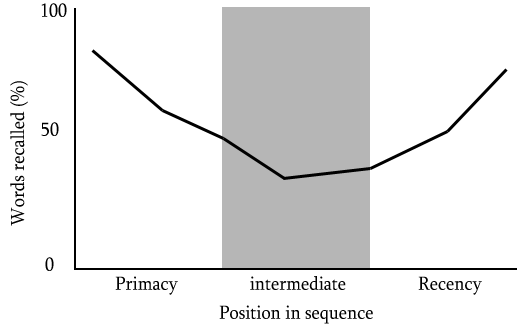
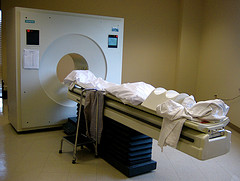 The positron emission tomography (PET) scan measures blood flow in the brain. This is accomplished by injecting a person or animal with a radioactive isotope (i.e. an unstable atom, usually a variation of oxygen that has a short-half life); this isotope will quickly decay. Founded on the assumption that blood flow will increase in areas of the brain that are in heavy use (such as when a person is viewing an object or reading words or some other cognitive-intensive function), a fair portion of the injected isotopes will end up in the active part of the brain. As the isotopes decay, a positron (a small particle with the exact opposite charge as an electron) is released. This positron will collide with an electron and they will annihilate each other, sending two gamma ray particles in exactly opposite directions. These gamma rays are picked up by the PET scanner, which then determines where they came from in the brain. Since blood should concentrate where the brain is activated, there should be higher levels of isotopes there and this will show up on the scanner in the form of increased levels of gamma rays. The test is usually run twice (once as the control condition and once as the experimental). The difference between the two conditions is measured and any difference should show what area(s) of the brain was (or were) activated.
 One experiment about cognitive brain functioning is the word superiority effect findings of Dr. Reicher in 1969. In this experiment either a word or a non-word (string of letters) is flashed on a screen. The subject is asked if the stimulus contained one of two letters, say a “C” or an “E”. When the stimulus did not resemble a word (e.g., XXCX) subjects were correct in identifying the target letter about 80% of the time. When the string of letters was similar to a word but not one (e.g., FELV) the subjects also correctly identified the target letter 80% of the time. However, the interesting finding was that when the stimulus was a word (e.g., TEND), subjects were correct in identification 90% of the time. So the word superiority effect is that subjects are most accurate in identifying a target letter when it is contained in a word as opposed to a string of letters.