Underlying Assumptions of Cognitive-Behavior Therapy

Cognitive behavior therapies (CBT) all have (or should have) the general underlying model of: Activating Event –> Schemas –> Thoughts –> Behavior/Emotions –> Outcome. In other words, there is a specific and precipitating event that is mentally interpreted, thought about, and acted (or not) upon; all of the steps following the precipitating and activating event lead to a consequence, or outcome. More specifically, our thoughts are really the cause of our behaviors and emotions – our behaviors are internally driven, even in the face of powerful external events. In order for this model to work there are a few basic assumptions that serve as the foundation for cognitive-behavior therapy.Psychotherapy Room

One of these assumptions is that cognitions affect and cause behavior. This goes beyond traditional behavior therapy because cognitions serve as mediating responses between the initial stimuli and behavioral responses. So in effect, it is our cognitions that cause behavior because how we interpret events determines how we react to them. Behavior also can affect cognitions but the general point is that cognitions are not only involved in the behavioral process but necessary to it.

Another assumption is that cognitions are not simply mysterious ephemeral processes – they can be measured, monitored, and altered. Asking people how they think and feel is thus a potentially effective way to understand their behavior. If cognitions can be measured they can also be altered. This means that the way that people think about the world and think about themselves can be changed, which is the goal of CBT when there is maladaptive behavior and cognitions.

As cognitions change, behavior may change. CBT does not ignore the role that changing behaviors (separate from cognitions) has in the therapeutic process but it is important to change cognitions to exact lasting behavioral change. Also, cognitive change is important in cases where situations and external influences on behavior do not, cannot, or will not change.

Image by Dinovitch.

Finals

I’m just finishing up finals and will resume posting next week. In the mean time, if you are a student in psychology and wondering what you can do with a degree in it, visit the APA’s website for resources.

Link to site.

Moral Development and the Brain

Moral reasoning is the ability a person has to reason in and through social, ethical, and emotional situations. One component of moral reasoning is moral behavior, which is the intentional and voluntary acting in a prosocial manner (Walker, 2004). Moral behavior and reasoning are the foundation for “many human social and cultural institutions such as family structures, legal and political government systems that affect the lives of virtually every person” (Eslinger, Flaherty-Craig, & Benton, 2004, p. 100). Often situations in life are morally ambiguous and involve a choice between two actions that both have consequences that may or may not be in opposition to each other. Some researchers, such as Lawrence Kohlberg, believe that people will reason through these situations at varying levels or stages, with some in a very concrete and egotistic manner and others in an abstract and universal manner.

Lawrence Kohlberg was the first researcher to come up with a major testable theory of moral development. He formulated six stages of development, with most adults reaching stage four, a few five, and very few stage six. The first two stages are at the pre-conventional level (typically self-centered and concrete reasoning), stages three and four are at the conventional level (recognition of social norms and laws), and the last two stages at the post-conventional level (recognition of universal rights and responsibilities). While Kohlberg’s theory of moral development is a stage model, the progression through the stages is not necessarily viewed as invariant. This means that people reach them at different rates and do not always reason at a particular stage with any given dilemma. There is significant variability within and between people in moral reasoning abilities. Most research focuses on between-person variability.

Continue reading “Moral Development and the Brain”

Moral Development

Reason and DesireLawrence Kohlberg developed a theory of moral development in humans that has been quite influential in emotion and moral reasoning developmental psychology. He believed that most adults reason at the 3rd or 4th stage level. A few reach the 5th and very few reach the 6th. However, people can reason at different levels at different times, with someone using stage 5 reasoning one day and stage 3 the next. However, people do tend to reason at one particular level more often than at other levels. The stages of moral development are as follows:
Rules outside oneself

Stage 1: Heteronomous morality

  1. Punishment-and-obedience orientation
  2. What is wrong is punished
  3. What is right is rewarded or not punished

Stage 2: Individualism, instrumental purpose, and exchange

  1. Naïve hedonism
  2. Egocentric or needs-based

Continue reading “Moral Development”

The beginnings of functional neuroimaging

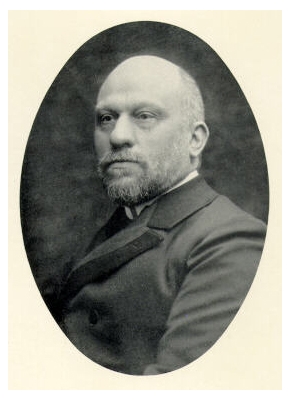
Angelo MossoAngelo Mosso was an Italian physiologist, interested in many things but among them, blood flow and blood pressure in humans. He was born in Turin in 1846 to a father who was a carpenter by trade. Showing great promise in school, Mosso was able to attend the University of Turin and study the natural sciences. Always the consummate and prodigious researcher, over the course of his career he published more than 200 articles and books. Mosso’s work helped lay the foundation for many important (and modern) neuroscientific research methods, such as fMRI and the polygraph.
Mosso demonstrated in the late 1800s an increase in brain blood vessel pulsation as people thought about things. He interpreted this to mean that blood flow increased to the brain when people had thoughts. This particular study was one of the first (documented) functional neuroimaging (of sorts) studies. Both fMRI and PET are based on the idea that increased blood flow to the brain is associated with changes in cognition. It’s doubtful that he could have imagined how influential this research would be.

Visit this site for a longer biography of Mosso.

The neuroscience of aging

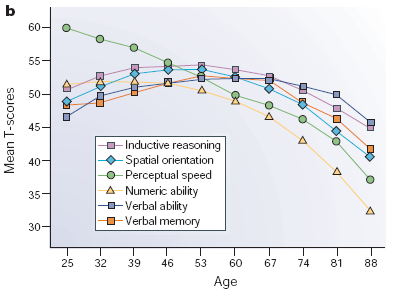
I’ll start with the bad news first. The human brain reaches it’s physical peak around the age of 25. After that it’s all downhill. The prefrontal cortex and underlying white matter is the last area of the brain to develop (including myelination); that area is also the first to start the decline. Myelination of the frontal cortex typically isn’t completed until the early to mid 20s. Its slow degradation starts quickly after it finishes development. This slow degradation of the brain correlates with slowed processing speed initially and, later in life, with declines in all areas of cognition. The good news is that cognitive performance in most areas does not typically decline until the mid 50s; many abilities such as verbal continue to increase until the mid 50s or early 60s. While there is often global brain matter loss (slowly over the decades), specific areas of the brain change at different rates (with some areas exhibiting volume increases until the mid 50s or so).

This news can be discouraging for people who are older than 25 (such as myself) – knowing that I am on the downward slope, at least as far as brain volume, myelination, and processing speed are concerned. I wrote about the bad news first so now the good news. Even though cognitive performance starts to decline, on average, in the mid 50s, many domains increase between age 25 and age 55; thus, the declines in late life often merely bring cognitive performance back down to where it was in the mid 20s. Of course processing speed in late life is a lot lower than in the early 20s but verbal memory and abilities, reasoning, and spatial abilities are quite intact in late life. Math abilities tend to decrease significantly over life though. The graph shows cognitive performance as measured by a 35-year longitudinal study (actually a sequential research design – both cross-sectional and longitudinal) (Schaie, K. W. Intellectual Development in Adulthood: The Seattle Longitudinal Study. Cambridge Univ. Press, Cambridge, 1996).Cognition across the lifespan

For a comprehensive review of cognitive and neurological changes associated with aging read Trey Hedden and John D. E. Gabrieli’s Nature Review: Neuroscience article published in February 2004. I’ve included a link to a PDF of the article: Aging article.

Optical Illusions That Make You Fatter and Your Wallet Lighter

“Eat from small plates, drink from taller glasses.” Optical illusions lead us to eat and drink more, as illustrated by the examples in this article. There’s an old saying in cuisine…”the first bite is with the eye.”

Interesting article. I’m not sure if there is empirical data to support it but it does show that our perception of our food can affect how much we eat. Our actions are affected by so many different things, many of which we might not be aware.

read more | digg story

The Threat of Obesity

The APA online linked to an article from the UK about the threat of obesity. With all of the recent news about climate change, some people are pointing out a threat that is as bad or worse than climate change: obesity. As a clinician I haven’t dealt with obesity issues (i.e., helping people with weight problems learn how to control their eating better) yet but it causes a lot of problems for people.

clipped from www.psycport.com

Obesity Is As Serious a Threat As Climate Change, Says Minister

Alan Johnson, the Secretary of State for Health, warned yesterday
that Britain’s obesity crisis is as serious as climate change and
will demand a review into whether the current ban on junk food
advertising to children is tough enough.
The call for fresh restrictions on TV ads for junk food comes as
new government research reveals this week that half of all adults
could be clinically obese by 2050.

  blog it

Birth Order and IQ

I “clipped” this off of CNN for a couple reasons. One is to comment on the fact that I first saw this research months ago – CNN is pretty slow sometimes – okay, slow most of the time – at reporting new research. Second, even though there was a statistically significant difference between IQ scores of 1st, 2nd, and 3rd born children, there is only a difference of 3 points between 1st and 3rd. That doesn’t really mean anything in real life. Also, this is significant in part as a result of the huge same size – 200,000+. Additionally, the subjects all were male. There are other limitations pointed out in the CNN article.

We shouldn’t be so set on statistical significance (I worry about it in my research, of course). There is internal and experimental validity and then there is ecological validity. Intelligence research means very little without good ecological validity.

clipped from www.cnn.com
But the debate over the impact of birth order gained new urgency this summer when the results of a new study were announced: Firstborns’ IQs tend to be higher than those of their younger siblings.
Does that mean later-born kids are destined to be less accomplished and successful? Studies like this don’t tell the whole story — and neither do birth-order stereotypes. Here’s how to bring out the best in each child:
Norwegian scientists analyzed test results and birth data from more than 241,000 military conscripts and found that oldest children had an average IQ of 103, second children came in at 101, and third-borns were at 100.

  blog it

Psycholinguistics and Language

Although I am not a psycholinguist I thought I would introduce basic principles of language.

There are four main components of language: phonology, semantics, syntax, and pragmatics.

  1. Phonology is the sounds of language.
  2. Semantics is the meaning of language.
  3. Syntax is the structure of language.
  4. Pragmatics is the use of language.

1. Phonology: language is made up of phonemes and morphemes. Phonemes are the smallest units of sound in a language (e.g., in English /p/ is a phoneme) and morphemes are the smallest units of meaninful sounds. Morphemes may be smaller than words (e.g., -ing) or may even be words (e.g., call); the word calling is thus composed of two morphemes.

2. Semantics refers to the meanings of words. In general, semantics helps us understand the difference between hymn and him. In psychology, semantics can be important as a way for understanding people’s language functioning. A person with Alzheimer’s Disease may have difficulty coming up with words that start with a particular letter (G, for example) but would do relatively better on a task where they need to name tools. Tools or animals or sports can all be considered semantic categories and are relatively structured in our memories. People who have better memories tend to have better memory strategies than people with poorer memories have. These strategies often include semantic categorization, where things that need to be remembered are grouped into categories.Woman Talking on Cell Phone

3. Syntax is the structure of language – the grammar. In English adjectives are typically placed before the objects (nouns) they are modifying – the red ball; in Spanish the adjectives go after the modified nouns – la bola roja. Syntax can have a significant impact on the meanings of sentences: “The boy hit the ball” versus “The ball hit the boy.” Both sentences have identical phonemes, morphemes, and semantics but differ in overall meaning as a result of different syntax.

4. Pragmatics refers to the use or application of language. It is typically viewed as a social aspect of language. Pragmatics is about applying language so that others understand what you are trying to convey. For example, someone who is good at pragmatics may be able to say one thing and convey a completely different message, if needed.

Each aspect of language can develop well or poorly in humans. Brain damage or degeneration can also selectively impair one of the aspects of language. For example, a person might have intact semantics, language production (phonemes and morphemes), and syntax but impaired pragmatics (this is referred to as a word salad or Wernicke’s aphasia – where a person strings words together that may even be grammatically correct but aren’t meaningful overall).

Image by wlau1.