Dealing with TBIs from the Iraq War

I read a good article on CNN that details some of the problems that veterans and health professionals face when dealing with TBIs acquired during military action. The article provides a good perspective of the “human side” of TBI.

Link to the story

I’ve posted about this topic before but felt that we should revisit it because so many veterans are affected by TBIs (as well as mental health issues). I don’t know the exact number of veterans affected by TBIs but studies have shown that >30% of soldiers and Marines have some sort of psychological issue related to their service in Iraq and/or Afghanistan. The military and the government are realizing how salient this problem is and will be.

“Congress included $900 million in the DoD’s supplemental budget fir fuscal years 2007 and 2008 to fund more mental health services, as well as more research on the effects of traumatic brain injuries (TBI) and treatments for TBI and post-traumatic stress disorder (PTSD)” (Monitor on Psychology, Sep. 2007, pp. 38-39).

Continuing the Introduction to Human Development

I’m now back in the country after my long and very eventful trip. The brain imaging conference was fabulous. Anyway, I just wanted to add a few more of my development lecture slides in PDF format. They are fairly brief and again, just outlines of the material but I tried to fill in a little more info.

I’ll post some more neuroscience material soon – I just have to get caught up on a week’s worth of missed school and related work.

Biological Influences on Development

Prenatal Development

Infant Development

Clinical Neuropsychology Defined

If you were like me a few years ago I had no idea what clinical neuropsychology was. I guess I should first start out with what clinical psychology is and how it differs from other disciplines. One common misconception that I run across is that I am studying to be a psychiatrist. Nope, psychologists are different from psychiatrists. Psychiatrists go to medical school, receive an MD, and specialize in psychological disorders after that. Since they are MDs they can prescribe drugs (and often believe – if I can stereotype – that drugs are pretty close to panaceas). Psychologists earn PhDs (or, PsyDs) in the United States from clinical psychology programs. After grad school and an internship, psychologists need to pass the licensing exam in a state to be able to see clients and patients.

Neuropsychologists specialize in brain functioning and typically see clients with brain disorders. The problems can range from epilepsy to autism to learning disorders to traumatic brain injuries to dementias. Neuropsychologists generally want to understand how brain (dys)function affects performance on various tests. Conversely, they believe that test performance reaveals much about how the brain is or isn’t working and where any damage might be. Neuropsychologists also commonly use MRIs and other brain imaging techniques to provide more information about their clients.

What are the job options for someone with a PhD in Clinical Psychology (emphasizing neuropsychology)? There is always academia, where research and teaching are king. Many neuropsychologists in academia also see patients clinically. Neuropsychologists can also work in hospitals, clinics, or private practice. A number conduct forensic evaluations for legal cases (e.g., work-related injuries, automobile collisions, etc.). The military also employs a number of neuropsychologists. Some neuropsychologists also work for business or governmental agencies as consultants, statisticians, or psychologists. While psychologists do not make as much money as MDs, they generally are paid well, have good hours, and good job security.

The Brain From Top to Bottom

Today I discovered an interesting site about the brain. From the site: Each currently available topic…takes you to several sub-topics, with 5 levels of organization and your choice of 3 levels of explanation.” You can choose the level at which you want the topics explained – basic to advanced. The site covers the topics: “From the Simple to the Complex,” “Memory and the Brain,” “Pleasure and Pain,” “Emotions and the Brain,” “Evolution and the Brain,” “Body Movement and the Brain,” “The Senses,” “Mental Disorders,” “How the Mind Develops,” “From Thought to Language,” “Sleep and Dreams,” and “The Emergence of Consciousness.” The last two topics have not been posted yet, however.

Here’s the link to The Brain From Top to Bottom

The site is simple and nicely organized. The information on it looks like it is accurate and, at the advanced level, seems like it is written at a High School or College level.

The site is published by The Canadian Institutes of Health Research and The Canadian Institute of Neurosciences, Mental Health and Addiction. It is available for free to the public and can be used however someone sees fit.

Introducing Developmental Psychology

I’m sorry for the bereft of posts recently. I’ve been talking vacation since summer classes ended. Classes start up again in about a week. Once again, I’m sorry for not updating.

I used to teach a lifespan development class. I’ve posted the slides from the first couple of lectures. I briefly cover the topics of development in general as well as a number of the theories of development. As these were lecture slides, they are merely outlines and not packed full of information but the info they provide should be sufficient to obtain a basic knowledge of the concepts. At the very least it can serve as a springboard in the the vast pool of developmental psychology.

The lectures are in PDF format.

Overview of Developmental Psychology

Developmental Theories

Time for an OCD Post

Time has a nice article about obsessive-compulsive disorder (OCD) titled “When worry hijacks the brain.” Like most articles by journalists, it’s a bit melodramatic (e.g., “Even the most stable brain operates just a millimeter from madness”) at times but overall it is a nice introduction to OCD and the biology (neuroscience) behind the disorder.

Self-handicapping, ability judgments, and self-esteem

The following post is a summary of some social psychology research from 2001 about the interplay between self-handicapping, ability, and self-esteem. While I focus mainly on neuroscience in general, I have many broad interests within psychology; hence, this post about social psychology.

McCrea & Hirt (2001) studied the effects of self-handicapping on ability judgments and self-esteem. In reviewing past literature the authors explained that while a lot of research was done on self-handicapping it was not clear whether global self-esteem affected ability judgments or vice versa, which was the basis of this study. Most self-handicappers apparently handicap themselves as a protective but not as an aggrandizing measure–it would be dangerous for a self-handicapper to have more expected of her or him. According to past research there are two reaction chains of relationships between self-handicapping, self-esteem, and personal beliefs of ability. As stated earlier attributions of ability either lead directly to self-esteem or to ability beliefs; in other words, people will attribute their success/failure on a test to either their personal abilities or external things (“I had to walk the dog and I didn’t have time to study enough”). The researchers’ hypothesis was that self-handicapping would have consequences on specific and global ability judgments which judgments were related to overall self-esteem.

The participants of the study were over 150 introductory psychology students (the majority were women) at Indiana University-Bloomington. There were three sessions of the study. In the first session the participants completed a self-handicapping scale and a self-esteem inventory. This session was done at the beginning of a the semester. The second session took place after at least one exam and just before another. In this session items were included that measured claimed handicapping behaviors such as textbook reading, studying, and other test preparations. The subjects also rated themselves on stress with a stress inventory. During the third session, which took place about a week after the next exam, the participants were asked about their performance on that exam. Then they rated how much the test was based on their own ability or if their score was a result of external forces (i.e. lack of study). There were also scales of other personal traits and the students’ current affect.

In this study the main items measured (the dependent variables) were: claims of poor preparation, claims of stress, test outcome, ability attribution, posttest self-esteem, posttest affect, academic ability, social competence, athletic ability, creativity, and psychology ability. The researchers did a regression for the analyses of these variables using the traits of self-handicapping, sex, and self-esteem as the independent variables. They classified four types of individuals: high self-handicapping (HSH), low self-handicapping (LSH), high self-esteem (HSE), and low self-esteem (LSE).

There were various self-handicapping measures (SHM) the authors looked at (the dependent variables). The first was claimed poor preparation. They found that men and HSH individuals claimed to have prepared less for the exams than did women or LSH individuals. They also found that HSE-HSH men prepared the least for the exam. The second SHM was claimed stress. HSH people reported more stress than LSH individuals but women and LSE individuals reported higher stress than men and HSE people. Overall, in test performance, HSH individuals did worse than LSH people. For ability attributions students blamed poor test performance on poor preparation and good test performance on personal ability, in general. For the posttest self-esteem measure the researchers found that HSH individuals had higher self-esteem whether they did well or poorly on the test.

In this study the authors found that self-esteem was higher the more individuals attributed their success to ability, which these researchers interpreted as ability attributions mediating claimed handicaps and self-esteem—so claimed handicaps affected ability attributions which in turn affected self-esteem. Generally, as far as ability ratings go, men and HSE individuals rate themselves as holding higher abilities than women and LSE individuals do. One interesting finding was that HSE-HSH men rated their abilities in psychology significantly higher than non HSE-HSH individuals even though they scored much lower on the test. This shows that the HSE-HSH persons had a scapegoat to blame for their poor performance­—poor preparation. Lastly, although global self-esteem slightly increased prediction of psychology ability ratings (those who had higher self-esteems could be shown to have slightly higher specific ability ratings), the psychology ability rating was a significant and large predictor of global self-esteem (those who rated their specific ability highly would have significantly higher overall self-esteem).

The authors’ interpretations of their statistics is that claimed handicaps affect ability beliefs and those beliefs then affect global self-esteem and not vice versa. So self-handicapping not only affects individuals overall self-esteem but more specifically, their “beliefs of ability in a threatened domain [in this case, students’ beliefs about how good they are at psychology]” (1388).

Reference

McCrea, S. M. & Hirt, E. R. (2001). The role of ability judgments in self-handicapping. Personality and Social Psychology Bulletin, 27, 1378-1389.
Volunteering as Therapy for Individuals with Dementia of the Alzheimer’s Type

The following post is a lengthy exposition on a possible link between volunteering and Alzheimer’s disease. This post is more social psychology then neuroscience (actually, it has very little to do with neuroscience). I am not asserting that volunteering can be a useful therapy for someone with Alzheimer’s disease, rather I am making the case that there is enough evidence for research to be conducted along those lines. In other words, I see a need for someone to research whether or not volunteering is beneficial for people with Alzheimer’s disease.

Alzheimer’s disease (AD) is a serious condition that affects an estimated four million people in the United States. Most of these people are over the age 65, since the risk of developing AD increases with age. It is also estimated that there are currently over 400 thousand new cases of AD each year in the United States alone (Rodgers, 2002). The prevalence rate of Dementia of the Alzheimer’s Type (DAT), according to the Diagnostic and statistical manual of mental disorders–fourth edition (DSM-IV) is “between 2% and 4% of the population over the age 65 years…[and] the prevalence increases with increasing age, particularly after age 75 years” (American Psychological Association [APA], 1994). (In this post, the terms AD and DAT are used as interchange terms, even though DAT is the Axis I code and AD is the Axis III code in the DSM–IV. This is done because most articles about Alzheimer’s use the term “AD” in lieu of “DAT”). For this post, I will first give the DSM-IV diagnostic criteria for DAT. Then, I will discuss the effects of that volunteering has on older people. I will also provide some background theories about why volunteering has the effects that it does. Next, I will make the connection between AD and voluntarism.

DSM-IV Criteria for DAT

There are six main criteria associated with DAT as found in the DSM-IV. The first is:

“The development of multiple cognitive deficits manifested by both (1) memory impairment (impaired ability to learn new information or to recall previously learned information) [and] (2) one (or more) of the following cognitive disturbances: (a) aphasia (language disturbance), (b) apraxia (impaired ability to carry out motor activities despite intact motor function), (c) agnosia (failure to recognize or identify objects despite intact sensory function), (d) disturbance in executive functioning (i.e., planning, organizing, sequencing, abstracting)” (APA, 1994, p. 142).

Continue reading “Volunteering as Therapy for Individuals with Dementia of the Alzheimer’s Type”

The Modal Model of Memory and the Serial Position Effect

I’m continuing my recent trend of basic cognitive psychology posts. The following post is about the Modal Model of memory, which has been highly influential for a number of decades but it is slowly being modified over time. I won’t get into the more modern modifications of the modal model, rather, in my post I present the very traditional view of memory, even if it is somewhat controversial today. For example, a number of psychologists do not believe that short term memory really exists (working memory fills in the gap). In any case, my post serves as a brief introduction to a classic view of memory and of the primacy and recency effects.

The modal model of memory has three main components. They are: sensory register, short-term memory (STM), and long-term memory (LTM). This Atkinson and Shiffrin model of memory assumes that the processes of moving information from the sensory store to short-term and then long-term memory takes place in discrete stages. At any of these stages information can be lost through interference or decay. Another assumption of this model is that information processing has to start in the sensory register and be attended to, then move to STM, and then to LTM with rehearsal.

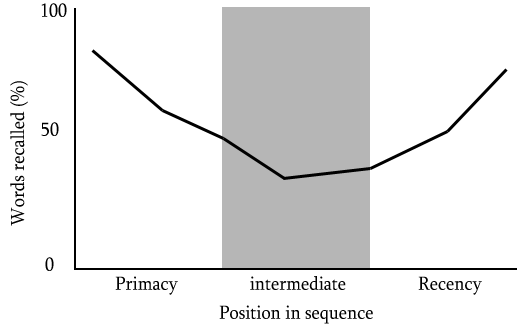
The serial position effect (split into the primacy and recency effects) is that the first few and last few items in a word list, for example, are the easiest to remember. A graph of this effect would be roughly parabolic (i.e., U-shaped). The primacy effect occurs because people have time to rehearse the first few items until the STM capacity is reached. The recency effect occurs because the last items are still in STM and have not decayed yet so they are easy to remember. The items in the middle of lists are easy to forget because STM capacity is too full for much rehearsal by then and as more items are presented, older items in STM are “pushed out.”

Serial Position EffectThere are ways to hinder the primacy or recency effects though. If items are presented rapidly then there is not time to rehearse the items and the primacy effect fades away. If there is a distracting task given at the end of the main task (similar to Peterson and Peterson’s 1959 study testing the decay rate of STM), then the recency effect disappears due to STM capacity being taken up by the distracters, which leads to decay of the information in STM. These findings indicate that the systems governing primacy and recency effects are separate. The findings also gave support to the modal model because researchers identified the primacy effect with the transfer of STM into LTM. The recency effect is just an example of information being in STM.

Alternate assumptions to naturalism in neuroscience

Thinking ManThis post is very different than anything I’ve previously written; it’s more philosophical than psychological and is an example of Theoretical and Philosophical Psychology, a small but important niche within psychology that provides critical analyses of the underlying assumptions [philosophies] of psychology and the related sciences. My post is not meant to attack the neurosciences (after all, that is my field of specialization); rather, it is meant to expose the philosophical underpinnings of neuroscience. The alternative assumptions I write about are not necessarily superior, just different. Feel free to contact me with any questions or if you are interested in the references I cite.

This post is an exposition of the naturalistic assumptions in the article An fMRI Study of Personality Influences on Brain Reactivity to Emotional Stimuli by Canli et al. (2001). It will also focus on alternative assumptions. I will first explore the assumption of materialism, one half of Descartes’ dualism, and contrast this assumption with a holistic monism. Then I will discuss biological determinism as well as an alternative assumption to it, namely agency.

Materialism accounts for one half of the Cartesian dualism (and thus has been termed a one-sided dualism), the theorized split between mind and matter. It is defined as the notion that “biological explanations will (eventually) be able to fully account for and explain…psychological phenomena” (Hedges, p. 3). Materialism assumes that biology is sufficient to explain behavior. This article is focused on “the neural correlates of emotion [and personality] in healthy people” (p. 33) by using brain imaging techniques. This is an example of materialism in that the authors are looking for “the biological basis [or an objective foundation] of emotion [a subjective phenomenon]” (p. 33). The authors’ assumption of materialism will become clearer with another example. Canli et al. state: “The similarity in the dimensional structure of personality and emotion is due to a common neural substrate where personality traits moderate the processing of emotional stimuli” (p. 33; italics added). What they are saying is that neurons (the brain) are the base and that emotional processing in the brain is affected by personality traits (which they state have a “common neural substrate” with emotions). This is a one-sided dualism—the researchers attempt to explain the subjective experiences of the mind (i.e., emotion) in terms of the material, or biological, body while not including the mind in their methods.

The authors of this study sought to understand emotional responses in terms of neuroimaging. This is an example of method-driven science in that the researchers “ignored…[the] notion of the mind [being immaterial and unpredictable] and focused…on the body” (Slife, p. 13). There is no way to image emotions directly, but by assuming that they are centered in biological reactions, these researchers were able to use traditional scientific methods to measure those reactions. This materialism, or one-sided dualism, has its shortcomings. An alternative way to approach the hypothesis of how personality serves as a “middleman” between the brain and emotions is to use the assumption of a holistic monism. Whereas the authors assume that the brain (body) is the foundation of emotional experience and thus sufficient for that experience, with a monistic assumption the researchers would recognize both body and mind as necessary but not separately sufficient. This would change their study because they would look at a more inclusive picture of people, not just biology and mind but context as well. All of these conditions interact and are only understood in relation to one another. The authors would also consider qualitative measures of life experience and meaning and research those, taking a pluralistic approach.

Another prevalent assumption, which is inseparable from materialism and is in fact a subset of it, is that of biological determinism. Whereas my materialism section focused on the authors’ attempts to explain subjective experiences by their “objective” methods, this one will focus on how they explain varying emotions as caused by variations in biological factors. The authors end their paper on a strong deterministic note: “The different brain activation patterns that these pictures produce…may result in two different subjective interpretations of the identical objective experience” (p. 39). Although they hedge their statement with a may, what they are saying is that their subjects all had the same “objective experience” but because of apparent differences in how their brains responded, this difference caused the variation in subjective emotional interpretation. They imply that people’s interpretations are determined by biology, which rules out agency.

Alternately, when viewing this article according to holistic monism, specifically agency, there are would be many changes in it. First off, it would not be a problem to recognize the role agency plays in the body. The authors would assume that the body affects agency and vice versa–they constitute each other. Instead of “different brain activation patterns” (p. 39) causing different interpretations of emotion it could be that the interpretations affect the neuronal firing instead (or an interplay of both). Also, with an alternative assumption, the following hypothesis would no longer be deterministic: “Extraversion is associated with greater brain reactivity to positive” (p. 34). The authors imply that personality traits are biologically based (see paragraph 2 of this paper)–even if behaviorally influenced; therefore, biology causes personality which causes changes in brain reaction (which are experienced subjectively by people as emotions). Alternatively, this can be explained by “agentic factors” (Slife, p. 25), such as people choosing (even unconsciously) how to respond to the pictures. Also, instead of personality being determined by the brain, manifestations of agency (choices) in a context (e.g., experiences) could shape personality.