At a Conference

My blog has been stagnant for a week or so because classes started back up and I have been preparing to attend a conference out of the country. I probably won’t have time to write any posts for over a week. Sorry for the lack of posts; I’ll resume when I get back in town.

Here’s a link to the abstract of an interesting new research article (in JINS) about how working memory is affected by severe TBI: Link

Clinical Neuropsychology Defined

If you were like me a few years ago I had no idea what clinical neuropsychology was. I guess I should first start out with what clinical psychology is and how it differs from other disciplines. One common misconception that I run across is that I am studying to be a psychiatrist. Nope, psychologists are different from psychiatrists. Psychiatrists go to medical school, receive an MD, and specialize in psychological disorders after that. Since they are MDs they can prescribe drugs (and often believe – if I can stereotype – that drugs are pretty close to panaceas). Psychologists earn PhDs (or, PsyDs) in the United States from clinical psychology programs. After grad school and an internship, psychologists need to pass the licensing exam in a state to be able to see clients and patients.

Neuropsychologists specialize in brain functioning and typically see clients with brain disorders. The problems can range from epilepsy to autism to learning disorders to traumatic brain injuries to dementias. Neuropsychologists generally want to understand how brain (dys)function affects performance on various tests. Conversely, they believe that test performance reaveals much about how the brain is or isn’t working and where any damage might be. Neuropsychologists also commonly use MRIs and other brain imaging techniques to provide more information about their clients.

What are the job options for someone with a PhD in Clinical Psychology (emphasizing neuropsychology)? There is always academia, where research and teaching are king. Many neuropsychologists in academia also see patients clinically. Neuropsychologists can also work in hospitals, clinics, or private practice. A number conduct forensic evaluations for legal cases (e.g., work-related injuries, automobile collisions, etc.). The military also employs a number of neuropsychologists. Some neuropsychologists also work for business or governmental agencies as consultants, statisticians, or psychologists. While psychologists do not make as much money as MDs, they generally are paid well, have good hours, and good job security.

The Brain From Top to Bottom

Today I discovered an interesting site about the brain. From the site: Each currently available topic…takes you to several sub-topics, with 5 levels of organization and your choice of 3 levels of explanation.” You can choose the level at which you want the topics explained – basic to advanced. The site covers the topics: “From the Simple to the Complex,” “Memory and the Brain,” “Pleasure and Pain,” “Emotions and the Brain,” “Evolution and the Brain,” “Body Movement and the Brain,” “The Senses,” “Mental Disorders,” “How the Mind Develops,” “From Thought to Language,” “Sleep and Dreams,” and “The Emergence of Consciousness.” The last two topics have not been posted yet, however.

Here’s the link to The Brain From Top to Bottom

The site is simple and nicely organized. The information on it looks like it is accurate and, at the advanced level, seems like it is written at a High School or College level.

The site is published by The Canadian Institutes of Health Research and The Canadian Institute of Neurosciences, Mental Health and Addiction. It is available for free to the public and can be used however someone sees fit.

Introducing Developmental Psychology

I’m sorry for the bereft of posts recently. I’ve been talking vacation since summer classes ended. Classes start up again in about a week. Once again, I’m sorry for not updating.

I used to teach a lifespan development class. I’ve posted the slides from the first couple of lectures. I briefly cover the topics of development in general as well as a number of the theories of development. As these were lecture slides, they are merely outlines and not packed full of information but the info they provide should be sufficient to obtain a basic knowledge of the concepts. At the very least it can serve as a springboard in the the vast pool of developmental psychology.

The lectures are in PDF format.

Overview of Developmental Psychology

Developmental Theories

Split-belt Treadmill as Therapy for Brain-injured Patients

CNN has an interesting article about a split-belt treadmill that is being used for stroke survivors and other people with brain injuries.

Story here

The treadmill’s two belts can move independently and even in opposite directions. Doctors and researchers are trying to find any underlying intact neural circuitry by providing unique motor challenges to brain injury patients.

Language Development and TV

Time is reporting about research conducted at the University of Washington showing a correlation between watching baby videos/shows and slower language development. That is, the more time that children spend watching TV, the fewer words they know, on average.Child and TVs

Here’s a link to the article.

This shouldn’t mean parents should rule out letting their kids watch TV or even edutainment but parents should be cautious about how much their kids really are watching. Also, they need to take time to play and talk with their kids – as much as possible. Really young children (less than 6-9 months) probably shouldn’t be watching any TV, especially if it is being used as a “pacifier” for them.

Time for an OCD Post

Time has a nice article about obsessive-compulsive disorder (OCD) titled “When worry hijacks the brain.” Like most articles by journalists, it’s a bit melodramatic (e.g., “Even the most stable brain operates just a millimeter from madness”) at times but overall it is a nice introduction to OCD and the biology (neuroscience) behind the disorder.

The 3D brain

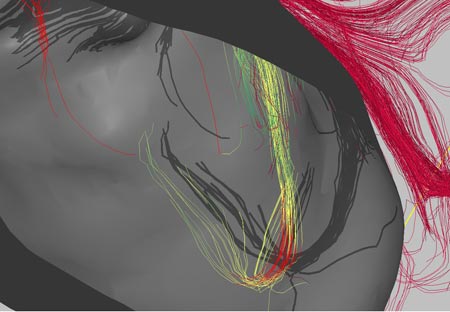
Technology Review has an interesting article about “new” 3D brain imaging software being developed at Thomas Jefferson University Hospital in Philadelphia, PA (I put “new” in quotation marks because there are other similar programs out there; they might not be as polished but some are even open source). Their software fuses MRI, fMRI, and DTI together to create a fairly comprehensive view of the brain: “The fusion of these different images produces a 3-D display that surgeons can manipulate: they can navigate through the images at different orientations, virtually slice the brain in different sections, and zoom in on specific sections.”

The software looks like it is aimed more at neurosurgeons than researchers (i.e., it probably isn’t free like a lot of MRI image processing software). It does produce amazing images (view the images here) and looks like it could be a very useful tool for at least a qualitative approach to brain imaging.

DTI fibers near a tumor

The software is focused a lot on DTI (diffusion tensor imaging) and how the white matter fibers in the brain interact with lesions or tumors. I think that one researcher’s word of caution is important:

“Bruce Fischl, an assistant in neuroscience at Massachusetts General Hospital, says that the idea is ‘interesting’ but cautions that there are a number of levels of ambiguity when talking about connectivity in imaging. ‘Just because you live next to the Mass Pike doesn’t mean that there is an exit,’ he says.”

In other words, don’t get too caught up in the fact that fibers are right by a tumor, they may not really have anything to do with the part of the brain the tumor is most affecting.

In any case, I think that the idea behind this software is amazing. The graphics renderings are impressive (but they are just the pretty pictures – the rendering details may be beneficial in clinical surgery settings but they are not particularly useful in research situations, other than producing nice pictures to go in your publication). This software is very similar to something that I envisioned using a few years ago and I’m glad to see it being developed.

Image credit: Song Lai, Thomas Jefferson University Hospital (borrowed via technologyreview.com)

The basics of MRI

For a simply fabulous introduction to magnetic resonance imaging (MRI) visit Dr. Hornak’s site: http://www.cis.rit.edu/htbooks/mri/

It provides a basic but very in-depth overview of MR imaging, including the statistics and physics behind the images. It’s probably the best freely-available resource about MRI on the web.

Self-handicapping, ability judgments, and self-esteem

The following post is a summary of some social psychology research from 2001 about the interplay between self-handicapping, ability, and self-esteem. While I focus mainly on neuroscience in general, I have many broad interests within psychology; hence, this post about social psychology.

McCrea & Hirt (2001) studied the effects of self-handicapping on ability judgments and self-esteem. In reviewing past literature the authors explained that while a lot of research was done on self-handicapping it was not clear whether global self-esteem affected ability judgments or vice versa, which was the basis of this study. Most self-handicappers apparently handicap themselves as a protective but not as an aggrandizing measure–it would be dangerous for a self-handicapper to have more expected of her or him. According to past research there are two reaction chains of relationships between self-handicapping, self-esteem, and personal beliefs of ability. As stated earlier attributions of ability either lead directly to self-esteem or to ability beliefs; in other words, people will attribute their success/failure on a test to either their personal abilities or external things (“I had to walk the dog and I didn’t have time to study enough”). The researchers’ hypothesis was that self-handicapping would have consequences on specific and global ability judgments which judgments were related to overall self-esteem.

The participants of the study were over 150 introductory psychology students (the majority were women) at Indiana University-Bloomington. There were three sessions of the study. In the first session the participants completed a self-handicapping scale and a self-esteem inventory. This session was done at the beginning of a the semester. The second session took place after at least one exam and just before another. In this session items were included that measured claimed handicapping behaviors such as textbook reading, studying, and other test preparations. The subjects also rated themselves on stress with a stress inventory. During the third session, which took place about a week after the next exam, the participants were asked about their performance on that exam. Then they rated how much the test was based on their own ability or if their score was a result of external forces (i.e. lack of study). There were also scales of other personal traits and the students’ current affect.

In this study the main items measured (the dependent variables) were: claims of poor preparation, claims of stress, test outcome, ability attribution, posttest self-esteem, posttest affect, academic ability, social competence, athletic ability, creativity, and psychology ability. The researchers did a regression for the analyses of these variables using the traits of self-handicapping, sex, and self-esteem as the independent variables. They classified four types of individuals: high self-handicapping (HSH), low self-handicapping (LSH), high self-esteem (HSE), and low self-esteem (LSE).

There were various self-handicapping measures (SHM) the authors looked at (the dependent variables). The first was claimed poor preparation. They found that men and HSH individuals claimed to have prepared less for the exams than did women or LSH individuals. They also found that HSE-HSH men prepared the least for the exam. The second SHM was claimed stress. HSH people reported more stress than LSH individuals but women and LSE individuals reported higher stress than men and HSE people. Overall, in test performance, HSH individuals did worse than LSH people. For ability attributions students blamed poor test performance on poor preparation and good test performance on personal ability, in general. For the posttest self-esteem measure the researchers found that HSH individuals had higher self-esteem whether they did well or poorly on the test.

In this study the authors found that self-esteem was higher the more individuals attributed their success to ability, which these researchers interpreted as ability attributions mediating claimed handicaps and self-esteem—so claimed handicaps affected ability attributions which in turn affected self-esteem. Generally, as far as ability ratings go, men and HSE individuals rate themselves as holding higher abilities than women and LSE individuals do. One interesting finding was that HSE-HSH men rated their abilities in psychology significantly higher than non HSE-HSH individuals even though they scored much lower on the test. This shows that the HSE-HSH persons had a scapegoat to blame for their poor performance­—poor preparation. Lastly, although global self-esteem slightly increased prediction of psychology ability ratings (those who had higher self-esteems could be shown to have slightly higher specific ability ratings), the psychology ability rating was a significant and large predictor of global self-esteem (those who rated their specific ability highly would have significantly higher overall self-esteem).

The authors’ interpretations of their statistics is that claimed handicaps affect ability beliefs and those beliefs then affect global self-esteem and not vice versa. So self-handicapping not only affects individuals overall self-esteem but more specifically, their “beliefs of ability in a threatened domain [in this case, students’ beliefs about how good they are at psychology]” (1388).

Reference

McCrea, S. M. & Hirt, E. R. (2001). The role of ability judgments in self-handicapping. Personality and Social Psychology Bulletin, 27, 1378-1389.